


Plant- pathogen interactions: How would plants survive an epidemic?
- Nov 14, 2020
- 4 min read
Updated: Jun 10, 2022
During the current crisis, everyone is facing difficulties. Amid a pandemic, the global population are being forced to adjust every part of our lives and undergo a complete attitude change. We hear a lot about antibodies, vaccines and immune systems. The capability of humans to survive, adapt and potentially gain immunity to dangerous pathogens is a complicated issue shrouded by social and political intricacies. All of this is important, fascinating and poignant, but considering this against a backdrop of the current threat to our health is often scary and overwhelming. I invite you to take a break from this and follow me instead to the wonderful world of plant - pathogen interactions.
Plants must encounter and defend against several types of pathogens, some more common than others, including bacteria, viruses, fungi, insects and nematode worms. All of these, humans and animals may also have to defend against. When faced with a potentially fatal pathogen like Covid-19, we humans rely on our immune systems as our defence. Plants also have an immune system, every cell in the plant can detect threats and form a response. In 1951, Harold Henry Flor observed and described the relationship between plants and pathogens: for each resistance gene in the plant, there’s a matching gene in the parasite: ‘Gene for gene resistance’ or gene triggered immunity. It was once thought to be a simple model, however it has since been shown that the plant immune system is far more complicated than this. The resistance genes work together in intricate networks. These networks enable the plant to act more effectively with a more robust detection and response system, even compensating for certain elements not working properly. The immune response is also able to adapt more easily to new pathogens, even whilst there is additional environmental pressure (Freeman and Beattie, 2008).

Different plant species have a magnitude of defence mechanisms. Some of these are external, for example; a thick waxy layer covering the leaves to protect from contact with pathogens. This thick layer provides a run-off system that repels water to avoid pooling water for fungal infection. Tiny hair-like structures called trichomes cover leaves to protect from insect attack by creating a physical barrier and even impaling hungry caterpillars moving across the leaves. Some plants have chemical defences such as toxins released in stinging nettles that cause irritation- or a sting. Physical deterrents like thorns and prickles are there to protect from larger herbivores. When protecting from microscopic pathogens, these external factors aren’t enough, and defences may have to come from within.
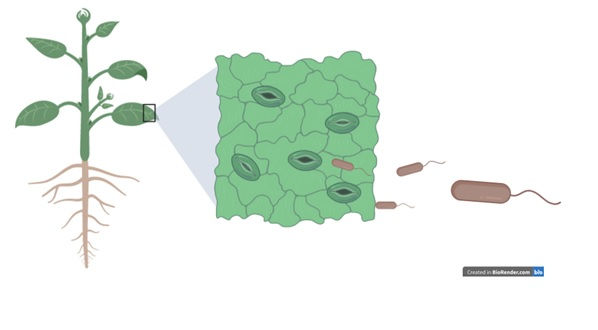
For plants to control water levels, and accumulate CO2 for photosynthesis, the process where they make food from light, they have pore-like structures called stomata that the plant opens and closes accordingly. These stomata can also provide a handy doorway for unwanted opportunists to invade the plant. The first line of defence for a plant to protect from invading pathogens is to close this access. On the entrance to these pores, there are guard cells which act like doors- they initiate a closing response in the presence of microbes. This is one of many defences that is referred to as ‘Basal resistance’ (Freeman and Beattie, 2008).
Each plant cell is surrounded by a cell wall which, in addition to maintaining leaf water pressure, also acts as a protective barrier and pathogen defence mechanism to each cell. These cell walls can be strengthened as a response to attack. This initiates communication to neighbouring cells, spreading the message that invasion is imminent. The plant can even kill its own cells to quarantine an infection and save the rest of the plant.
Plants and pathogens are in a back and forth race to form adaptations which offer each side survival. When a pathogen attacks, plants can adapt to prevent or survive this attack. When the plants adapt, the pathogens adapt further. Some diseases including: Bacterial Blast: Pseudomonas spiringae, a type of bacterial disease to plants, have developed an adaptation to release a toxin called coronatine which prevents the stomatal pores closing, enabling the bacteria to enter and proceed with infection (Aung et al., 2020). Some pathogens will release tissue-damaging enzymes which damage plants defences. The battle will continue. This fight provides very important impacts and implications for humans. We rely on plants for survival, not only in food, but clothing, hygiene, medicine and building materials. The demand for plants is increasing as the global population exponentially grows. In crops global losses of yield to pests and pathogens are significant, for example; 22.5% of maize, 17.5% of potato, 30% of rice, 21.5% of wheat and 21.4% of soybean (Savary et al. , 2019). In the past there have been epidemics that caused catastrophic damage. The Irish potato famine is a very famous example, Potato blight disease: Phytophthora infestans, a fungal disease that infected approximately half of the year’s yield causing widespread famine.
With a rapidly changing climate, not only is it becoming more difficult to grow crops under extreme conditions, but these conditions are preferable for pests and pathogens to thrive. Elevated temperatures, humidity, drought and flooding puts plants under considerable stress which causes significantly weakened defences against pests and pathogens, defences lose control, and are shut down allowing disease to flourish (Aung et al., 2020). It is now more important than ever that we develop our understanding of these mechanisms so we can further manipulate them for the benefit for agricultural ecosystems and global food security.
Miranda Burke
Originally written for Waitrose Agronomy Group research blog
http://wp.lancs.ac.uk/sustainable-agriculture/2021/01/29/plant-pathogen-interactions/
Aung, K. et al. (2020) ‘Pathogenic bacteria target plant plasmodesmata to colonize and invade surrounding tissues’, Plant Cell. American Society of Plant Biologists, 32(3), pp. 595–611. doi: 10.1105/tpc.19.00707.
Freeman, B. C. and Beattie, G. A. (2008) ‘An Overview of Plant Defenses against Pathogens and Herbivores’, The Plant Health Instructor. Scientific Societies. doi: 10.1094/phi-i-2008-0226-01.
Savary, S. et al. (no date) ‘The global burden of pathogens and pests on major food crops’. doi: 10.1038/s41559-018-0793-y.
Image created on BioRender.com


Comments